TL;DR
Dozer vs Bartender: For most Mac users in 2026, Dozer is the better choice for menu bar because it is free while Bartender charges for full use. Both install with a single Homebrew command, so the switching cost is low. Choose Bartender instead if you want menu bar.
Which is better: Dozer or Bartender?
Dozer is the top pick for most Mac users looking at menu bar. It is free and installs in one Homebrew command. Bartender is the stronger choice if you want menu bar. As of September 2026, both install with brew install --cask dozer and brew install --cask bartender.
Dozer vs Bartender
Which is the better menu bar for Mac in 2026?
We compared Dozer and Bartender across 6 key factors including price, open-source status, and community adoption. Read our full breakdown below.
Dozer
Free open-source menu bar manager that hides menu bar icons to keep your Mac tidy.
Bartender
Organize your menu bar icons
Visual Comparison
Bartender
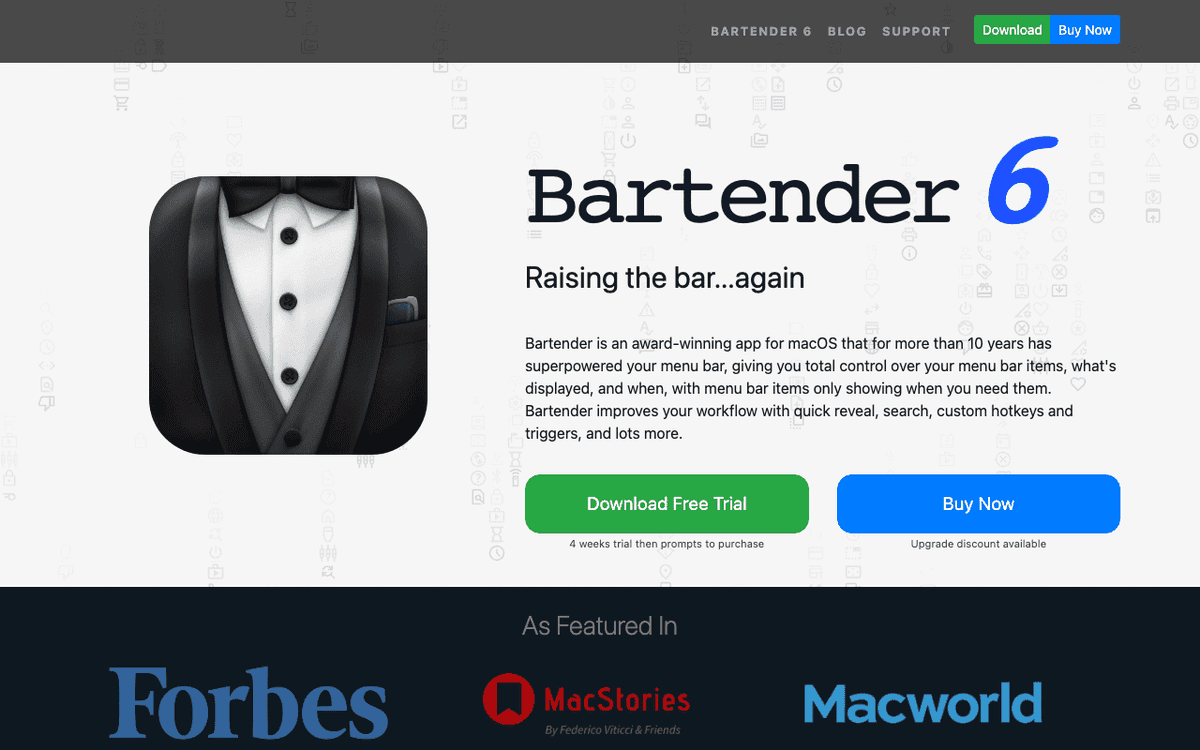
Bartender — Official Website
Our Verdict
For most Mac users in 2026, Dozer is the better choice for menu bar because it is free while Bartender charges for full use. Both install with a single Homebrew command, so the switching cost is low. Choose Bartender instead if you want menu bar.
Feature Comparison
| Feature | Dozer | Bartender |
|---|---|---|
| Price | Free | Paid |
| Open Source | No | No |
| Replaces | Bartender ($25) | — |
| Best for | menu bar, utilities, macos | menu bar, organize |
| Install | brew install --cask dozer | brew install --cask bartender |
| Category | System Utilities | System Utilities |
Quick Install
brew install --cask dozerbrew install --cask bartenderLearn More
In-Depth Overview
What is Dozer?
Dozer began as a lightweight open-source alternative to paid menu bar managers, popular for simplicity and zero cost. Developed by Mortennn on GitHub under MPL-2.0, it hides menu bar items behind Dozer dots with Cmd-drag placement and click-to-reveal. In August 2026 Dozer is best described as legacy software. The public repository still hosts releases and a Homebrew cask, but there is no active product cadence for macOS Tahoe menu-bar changes. The community has largely migrated to Ice, Thaw, Hidden Bar, or commercial Bartender. Dozer may still run for basic hiding on some systems, but notch MacBooks and new OS releases expose visual glitches with no vendor patch path. Treat Dozer as a migration source, not a destination for new setups.
What is Bartender?
Bartender is the longest-running commercial menu bar manager for macOS. After the 2024 Applause/Applite ownership transition that sparked privacy debate, the product continued shipping. Bartender 6 is marketed as redesigned for macOS Tahoe with Liquid Glass support, faster reveal (swipe, scroll, click, hover), Bartender Bar overflow, notch access, styling, groups, presets, triggers, Quick Search, spacing, and widgets. Bartender Pro adds Top Shelf (Dynamic Island-style controls for Mac) and future major upgrades on a yearly plan; Mega Supporter is lifetime including Pro. A multi-week free trial is available, licenses work across your Macs, and Bartender remains on Setapp. It is the maintained power-user benchmark when you need more than basic hide/show.
Detailed Feature Comparison
Hiding & Revealing Logic
CriticalUses a simple two-dot system. You drag icons to the left of a 'hide' dot or a 'remove' dot. It relies on standard macOS drag-and-drop. While functional, it often struggles with 'notch' MacBooks, where hidden icons can sometimes get lost or fail to re-flow correctly when revealed.
Offers a 'Bartender Bar' (a secondary bar beneath the main one) or an expansion mode that reflows hidden items. It handles notch-screen overflow so icons stay clickable. Users can choose hover-to-reveal, click-to-reveal, or swipe gestures.
Verdict: Bartender handles the physical limitations of modern MacBook screens (the Notch) perfectly, whereas Dozer often feels clumsy.
Automation & Triggers
HighNon-existent. Dozer is strictly manual. Icons are hidden until you click to show them. There is no logic to auto-reveal an icon if an app needs attention.
The 'Smart Triggers' feature is a major improvement. Bartender can automatically show the Battery icon when charge drops below 20%, or show the Wi-Fi icon if the internet disconnects. It turns the menu bar into a dynamic dashboard that cleans itself up.
Verdict: Bartender can auto-show icons when conditions change; Dozer only reveals them when you click.
Search & Quick Access
MediumDozer offers no search functionality. If you have 40 menu bar apps, you must manually hunt for the icon you need after expanding the bar.
Includes a built-in 'Quick Search' feature, a Spotlight-like interface specifically for menu bar items. You can type 'Volume' or 'Bluetooth' to instantly find and activate that menu item without taking your hands off the keyboard.
Verdict: For power users with dozens of background apps, Bartender's search is indispensable.
Visual Customization
MediumYou can only customize the toggle icons (the dots). No support for spacing, rounding, shadows, or tinting the menu bar itself.
Allows extensive styling. You can change the spacing between icons (reducing clutter), add rounded corners to the menu bar (aiding the macOS Tahoe 26 aesthetic), and apply custom tints or borders to the Bartender Bar.
Verdict: Bartender allows you to design your menu bar's look; Dozer just organizes the existing mess.
Notch Support
CriticalDozer does not natively understand the Notch. On 14-inch and 16-inch Pros, expanding a large set of icons can result in items 'disappearing' behind the camera housing, requiring users to juggle icon order manually.
Built specifically with the Notch in mind. It treats the space under the notch as a valid expansion area or uses a secondary bar to ensure 100% visibility of all items regardless of screen real estate.
Verdict: If you own a MacBook with a notch (M-series Apple Silicon MacBooks), Bartender is the only safe choice.
Privacy & Transparency
HighOpen-source and auditable. It requires minimal permissions and makes no network connections. There are no analytics SDKs or tracking code, making it the preferred choice for privacy absolutists.
Since the 2024 acquisition, Bartender includes analytics (Mixpanel) and requires broader permissions (Screen Recording) to function. While the developers claim data is anonymized, the closed-source nature and ownership change created a permanent trust deficit.
Verdict: Dozer wins effortlessly on trust. Bartender requires you to trust a corporation with invasive system permissions.
System Footprint
MediumExtremely lightweight. It is a tiny binary that hooks into standard macOS APIs. Memory usage is negligible, often sitting under 20MB.
Surprisingly efficient given its feature set. While it uses more RAM than Dozer (50-100MB), it is highly optimized for Apple Silicon and causes zero perceptible lag during operation.
Verdict: Both are efficient enough that performance is rarely a deciding factor on modern Macs.
Who Should Choose Which?
1The Minimalist Developer
This user likely has a simple setup, uses Homebrew (even if casks are old), and hates 'bloat.' They want the icons gone and don't care about triggers. However, they should strongly consider 'Ice' as the modern replacement for Dozer.
2The Content Creator
Screen recording requires a clean menu bar. Bartender allows them to create a specific 'Recording' profile that hides everything except the clock and battery, toggled instantly.
3The MacBook Air User (Notch)
Limited screen width + Notch = Disaster with Dozer. Bartender is essential here to prevent icons from becoming inaccessible behind the hardware camera cutout.
4The Privacy Advocate
This user refuses to install software that pings a server. Dozer (or a self-compiled fork) is the only option that satisfies their security model, as Bartender's analytics are a dealbreaker.
5The Enterprise Power User
They have 50+ apps (VPNs, Docker, Cloud storage). They need search to find icons and automation to manage the chaos. The cost is irrelevant compared to the productivity gain.
6The Developer Running Many Status Bar Apps
Developers who run a dozen or more menu bar utilities, Docker status, GitHub notifications, database monitors, VPN indicators, cloud sync tools, and Homebrew update checkers, need Bartender's intelligent management. Its search feature lets you find any hidden icon instantly by typing its name, and the trigger system can surface specific icons only when they need attention (like showing the Slack icon only when you have unread messages). This level of smart automation turns the menu bar from a cluttered mess into an informative dashboard that shows exactly what matters at any given moment.
7The Mac Minimalist Who Just Wants Clean Aesthetics
Users who simply want to hide a few rarely-used icons with zero configuration overhead will find Dozer perfectly sufficient. There is no settings window to explore, no license to manage, and no login required, just a dot in your menu bar that acts as a divider between visible and hidden icons. For someone who only needs to hide the Spotlight icon, Time Machine indicator, and Bluetooth symbol, Dozer's simplicity is a feature, not a limitation. It does exactly one thing and does it with zero friction.
8The IT Professional Setting Up Employee Machines
IT teams deploying standardized Mac configurations benefit from Bartender's ability to preset which menu bar icons are visible, hidden, or always shown. The configuration can be exported and applied across multiple machines for a consistent look. Bartender also behaves more predictably across macOS updates: paid support and active development usually ship compatibility patches soon after each release. Dozer's unmaintained status makes it a riskier choice for enterprise deployments where reliability is critical.
Migration Guide
Dozer → Bartender
Migrating is an upgrade experience. Uninstall Dozer completely (delete the app and check ~/Library/Preferences for plist files) to ensure no conflict in hook permissions. Install Bartender. You will need to re-configure which items are hidden, as Bartender uses its own internal list rather than the physical position of icons. Enjoy the new 'Always Hidden' section for items you never need to see.
Bartender → Dozer
This feels like a downgrade. You will lose your triggers, search, and layout settings. Uninstall Bartender and revoke its Screen Recording permissions in System Settings > Privacy. Install Dozer. You will likely need to Command-Drag icons manually to the left of the Dozer dots. Be prepared for some icons to misbehave near the Notch.
Pro Tips
If you are leaving Bartender due to privacy concerns but find Dozer too basic, look for 'Ice' (by Jordan Baird). It is the spiritual successor to Dozer, offering open-source code with modern features closer to Bartender's level.
Final Verdict
Bartender 6: migrate off Dozer
Winner
Runner-up
Scores are Bundl.run editorial ratings out of 10 across 7 criteria (the feature comparison above), last reviewed August 2026.
In August 2026 Dozer vs Bartender is not a balanced feature contest. Bartender 6 is a polished, Tahoe-ready utility with automation and notch support. Dozer is a free relic that may still hide icons on some machines but is not a responsible long-term choice. Privacy-conscious users who refuse Bartender should migrate to maintained open-source tools (Ice/Thaw), not cling to Dozer. The verdict is clear: use Bartender (or a maintained free alternative); move off Dozer.
Bottom Line: Uninstall Dozer on modern macOS. Buy Bartender 6/Pro (or use Setapp) for full control; choose Ice/Thaw if you need free and open-source.
Video Tutorials
Bartender for Mac - Secret to a CLEANER Menu Bar!
Aim Apple • 2.8K views
Bartender 5 Review: Maximize Your Mac's Menu Bar!
MacBook Gaming • 6.2K views
How to make it look like you have bartending experience #Bartender #newbartender #bartendertraining
Michelle The Bartender • 4.9M views
Bartender Mac App #shorts
Greg Kocis • 1.2K views
Frequently Asked Questions
About the Author

Explore More on Bundl
Browse menu bar apps, read our complete guide, or discover curated bundles.
Sources & References
Fact-CheckedLast verified: Aug 9, 2026
Key Verified Facts
- Bartender 6 is marketed as rebuilt for macOS Tahoe with Liquid Glass support and full menu bar management features.[cite-bartender-site]
- Bartender sells Bartender 6, Bartender Pro, and Mega Supporter tiers with trial and upgrade paths.[cite-bartender-purchase]
- Dozer is an open-source menu bar icon hider hosted on GitHub under MPL-2.0.[cite-dozer-github]
- 2026 Mac press reports Bartender Pro around $15/year, Bartender 6 around $20 one-time, and Mega Supporter around $80 lifetime.[cite-macrumors-pro]
- Bartender's 2024 ownership change was widely covered and raised community privacy questions.[cite-macrumors-ownership]
- 1
- 2
- 3
- 4
- 5
- 6
- 7
Research queries: Bartender 6 pricing 2026; Dozer Mac status; Bartender Tahoe Liquid Glass